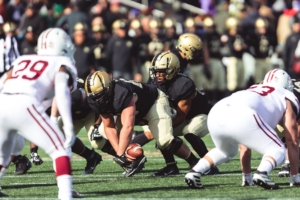


Last week, we dove deep into Army’s offense. This week, we’ll take a look at the Bad Boys on defense. The Black Knights will have a lot more new guys on defense this season than they have on offense. In addition to needing some new linebackers and at least one new safety, they have to find a way to integrate several new coaching hires.
Intensity on the rise 📈#GoArmy pic.twitter.com/uD1ZNs3MKg
— Army Football (@ArmyWP_Football) August 13, 2026
New Defensive Coordinator
Army has a new Defensive Coordinator this year in long-time Secondary Coach Daryl Dixon. Dixon has been in the program for the past eleven years, serving in various capacities on defense. He’s an internal hire, which usually means that the Staff doesn’t want to make wholesale changes to their scheme. Prior to West Point, he was Ball State’s cornerback and safeties coach. Most recently, Army made him its Defensive Pass Game Coordinator, where he had tremendous success. Army’s passing defense has been truly outstanding for several years in a row. Last year, the Black Knights finished 27th nationally in pass defense, having allowed just 190 passing yards/game. Dixon also coached arguably the most successful defensive back in Army’s modern history, Elijah Riley, who went on to play in the NFL for four years.
Coach Dixon is joined by Assistant Head Coach and Outside Linebackers Coach John Loose. Loose has been with the team for twenty-one seasons. Co-Defensive Coordinator Scot Sloan returns to the Black Knights as their new Safeties coach following a stint at Samford University. Similarly, Linebackers Coach Justin Weaver enters his fourth season after returning to Army in 2023. Defensive Line Coach Jamere Hogue and Cornerbacks Coach Munir Prince are both new. Hogue comes off a series of jobs in the FCS. Prince most recently served at Eastern Michigan’s cornerbacks coach. Finally, Christian Long starts the 2026 season as the defense quality control coach.
For my money, Hogue has arguably the hardest job here. He not only has to learn his way around the peculiarities of West Point, he also has to coach perhaps the most uniquely undersized position group on Army’s Football Team. His success — and Coach Dixon’s ability to maintain the defense’s success overall — will go a long way towards determining how Army plays this season.
Follow our updated coaching staff roster with camp kicking off in August ✅ #GoArmy pic.twitter.com/WtRpAb1hIq
— Army Football (@ArmyWP_Football) July 31, 2026
Who Is Captain America This Year?
The biggest question mark on the 2026 Defense is: Who is going to step up at linebacker and safety? With Coach Dixon’s pedigree in coaching the secondary, there are enough players who have developed that we should see continued success in the defensive backfield. However, the middle linebacker positions are open, and long-time starters Andon Thomas and Kalib Fortner will not be easy to replace.
Thomas and Fortner combined for over 179 tackles from the inside linebacker position. That’s a lot. But on the field their leadership might have been just as important. Both guys served as team captains last year on a senior-heavy defense. Meanwhile, Army got outstanding safety play from firsties Collin Matteson and Casey Larkin. All of those guys will be tough to replace.
Why would you go play football at @ArmyWP_Football?
— Jon Gruden (@BarstoolGruden) August 5, 2026
Center Brady Small and Long Snapper Owen Walter talked to me about why they do what they do… so proud of these young men! pic.twitter.com/mQPwWzq5d3
Bend But Don’t Break
The defensive distribution of tackles was great for the team last season, but the defense still had two major issues. Stopping teams on third and fourth down and preventing scoring in the red zone have been staples of the Army Defense. By comparison with the American Conference Championship team, the effectiveness of the 2025 Defense is statistically evident.
2025 defense compared with the 2024 AAC Championship Team
| Defensive metric | 2024 AAC Champs | 2025 | Change |
| Record | 12–2 (8–0 AAC) | 7–6 (4–4) | –5 wins |
| Points allowed/game | 15.5 | 21.6 | +6.1 |
| Total yards allowed/game | 297.9 | 343.5 | +45.6 |
| Rushing yards allowed/game | 112 | 153.2 | +41.2 |
| Passing yards allowed/game | 185.9 | 190.4 | +4.5 |
| Yards allowed/play | 5.3 | 5.6 | +0.3 |
| Sacks | 25 | 15 | -10 |
| Interceptions | 18 | 8 | -10 |
| Opponent third-down rate | 41.4% | 44.8% | +3.4% |
| Opponent fourth-down rate | 42.5% | 58.3% | +15.8% |
| Red-zone scoring rate | 62.5% | 81.3% | +18.8% |
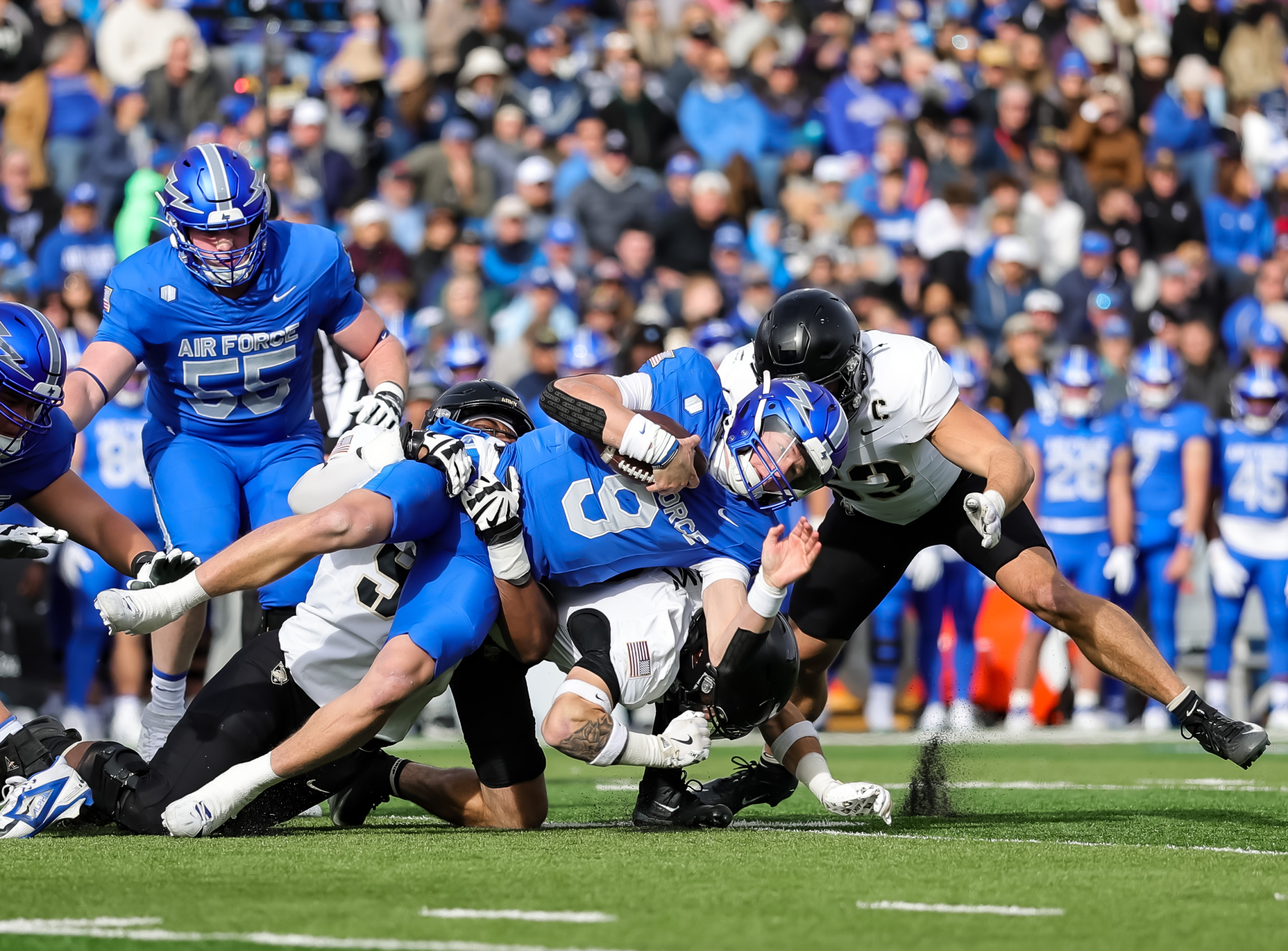
The standard bend-but-don’t-break approach wasn’t as successful last year, as the Red Zone scoring percentage increased by almost 20 percent. Coupled with a handful of tragic final scores late in the contests, Army dropped some heartbreakers in the fourth quarter and overtime last season.
AFF always notes that if a defense has been on the field for between 40 and 55 plays, they usually do well. Notably in the K-State win, the Defense was on the field for only 43 plays. In most of Army’s losses last year, the Defense averaged 69.5 defensive snaps.
This ties back to complementary football. Time-of-possession on the offensive side of the ball impacts the defense. When the offense doesn’t hold the ball, it creates opportunities for the defense to spend more time on the field, which increases the chances of something not going Army’s way.
We saw that all too often last season. Note that the passing defense never broke down last season. The issue usually turned on the team’s ability to hold up against the run.
Offense ➡️ Defense 🟰 Complimentary Football#GoArmy pic.twitter.com/iCzcoi6geW
— Army Football (@ArmyWP_Football) August 11, 2026
2026 Position Groups
Defensive Line
Army has returning players that should anchor the defense from the defensive line. This starts at the Nose with returning starting NT Kody Harris-Miller, who started 7 games last year and was an impact player until he was sidelined by injury. Miller is joined on the defensive front by Jack Bousum, a third-team All-American Conference selection who came on strong towards the end of last season.
Linebackers
Army has some big shoes to fill with team Captain and American Conference Scholar-Athlete of the Year Andon Thomas graduating and going on to bigger and better things in the Army.
The Black Knights have some returning production in the linebacking corps, but they don’t have guys with a lot of actual starts at linebacker. Noah Nixon looks to be a strong candidate to replace Ford as the edge rusher, and Baylor Newson and Elijah Walton were contributors last year and are now in the hunt for a starting job.
Safeties
Stephen Nnadozie returns at safety and is a Team Captain going into 2026. Nnadozie cannot replace both safeties that graduated, but his experience and maturity will make him a focal point for the defensive backfield.
Cornerbacks
Jayden Mayes will return as the cover corner and is poised to have another great season. Mayes is a reliable defender who has been consistent in his time in the Army. Jaxon Hammond will most likely start on the other side. He played a lot last year and is set to fight for a starting position in 2026.
Congrats to our guys who earned Preseason All-Conference honors from Pro Football Network 👏#GoArmy pic.twitter.com/WTCcHSNnSk
— Army Football (@ArmyWP_Football) August 10, 2026
Defensive scheme
Will we see an evolution of the defense with a new Defensive Coordinator?
Army has been consistent in stopping the passing game, ranking in the Top 30 in passing defense in recent years. Just as with the offense, there needs to be complementary football within the defense. On running downs, the D-Line needs to absorb blocks to allow linebackers to flow to the ball. On passing downs, the defensive line must get pressure on the opposing quarterbacks to not only increase the number of sacks (15 last year) but also to create opportunities for the secondary to get interceptions. Overall, the Army defense needs to be consistent, get off the field, and create more turnovers to give the Army offense more opportunities.
Final Thoughts
The 2026 Army defense needs to do what all Army defenses did in previous seasons. Control the line of scrimmage, get off the field, and control the red zone. Ideally, we’ll see more pre-snap movement from the defensive line. Maybe more stunts and blitzes will be added as the team matures and gets deeper in the season. The Black Knights also need to close out possessions in the fourth quarter. Finally, Army needs to win the turnover battle, which will lead to more opportunities for the offense to score, which will in turn create better opportunities to win.
Only time will tell, but the components of a championship defense are there. Now they just have to play the games.
Go Army! Beat Bryant!!!