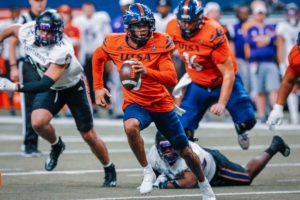
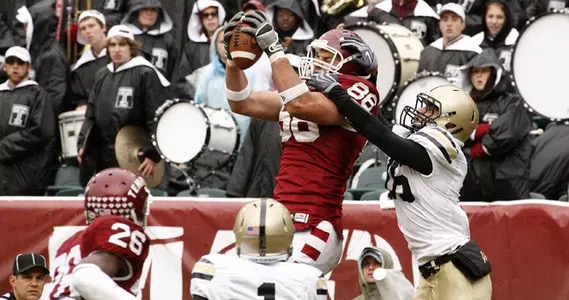


Saturday’s thrilling Temple-Army game showed signs of an American Conference rivalry with its best years still to come. The Owls and Black Knights are no strangers to one another. Saturday’s meeting was the 15th meeting all-time and 11th since 2007. Many Army fans will remember the schools meeting yearly from 2008-2013, but few may know that the two nearly added another meeting in a bowl within that span.
In head coach Rich Ellerson’s first year, Army’s 2009 team had a resurgent year. The Black Knights entered the Army-Navy Game with a 5-6 record. For the first time since 1996, the Army-Navy Game held added stakes. Before the season, the Black Knights agreed to participate in the EagleBank Bowl at Washington D.C.’s venerable RFK Stadium if it became bowl-eligible. It wasn’t pretty, but Army had gotten to the doorstep of its first bowl in 13 years.
That 2009 team was truly fascinating. The Black Knights did not have a single win over a team with more than two victories. The five teams they did beat entering Army-Navy had a combined record of 8-51.
Army’s offense that year proved to be one of the worst of the option era, averaging just 203.6 rushing yards per game and 15.3 points. Still, plebe QB Trent Steelman showed flashes of brilliance, putting up 706 rushing yards.
Surprisingly, the running game was not the most intriguing part of this team. 6’10” WR Alejandro Villanueva and Damion Hunter, a 5’10” speed merchant with 4.36 speed, formed one of the most fascinating receiving duos in the country that year. Villanueva made the rare conversion from offensive lineman to wide receiver and performed spectacularly, catching 34 passes for 522 yards and five touchdowns. His receptions became the second most by an Army receiver in the Black Knights’ 34 years running the option and the most yards in that span.
Villanueva overshadowed Hunter, his running mate, both literally and figuratively. However, Hunter also had a memorable season with 26 receptions for 162 yards and 818 kick return yards. Hunter’s 26 catches are the 4th-most in the option era, while his 818 kick return yards are the fifth-most in a season in program history. Together, Hunter and Villanueva alone accounted for 60 of Army’s 73 receptions (82%) and 684 of its 861 receiving yards (79%).
The defense made up for Army’s oddness on offense, allowing a respectable 21.9 points per game, good for 35th in the country. Legendary Army pass rusher Josh McNary had a year for the ages with 12.5 sacks and 22.5 tackles for loss, both second all-time in Army history. Donovan Travis picked off four passes in the secondary to solidify the pass defense.
In short, this was an interesting team that showed a potentially bright future for the Black Knights. If Army could break its then seven-year losing streak to Navy, they would meet Temple in their bowl game. The Owls received the nod because the ACC did not have enough bowl-eligible teams to fulfill its obligation to the EagleBank Bowl. This would become the Temple’s third bowl appearance ever and its first since 1979. The Owls had beaten Army earlier that year 27-13 despite the Black Knights outgaining them 256 yards to 195.
Ultimately, it was not meant to be. Army lost to Navy that year 17-3 after holding a 3-0 halftime lead. I remember crying on my parents’couch as a ten-year old wanting so badly to see Army play in a bowl game — any bowl game. The program needed any small bit of hope that it could get. Still, the Black Knights would return to a bowl the next year and actually win the 2010 Armed Forces Bowl over SMU.
Although they did not make a bowl, the 2009 team gave Army fans a glimmer of hope they had not seen in years. And while the Army-Temple rivalry has geography and a lively history working for it, a meeting in a bowl game would have added another element to the series. With both teams now in the same league, the wild 2009 EagleBank Bowl scenario is one that will likely never occur again.