
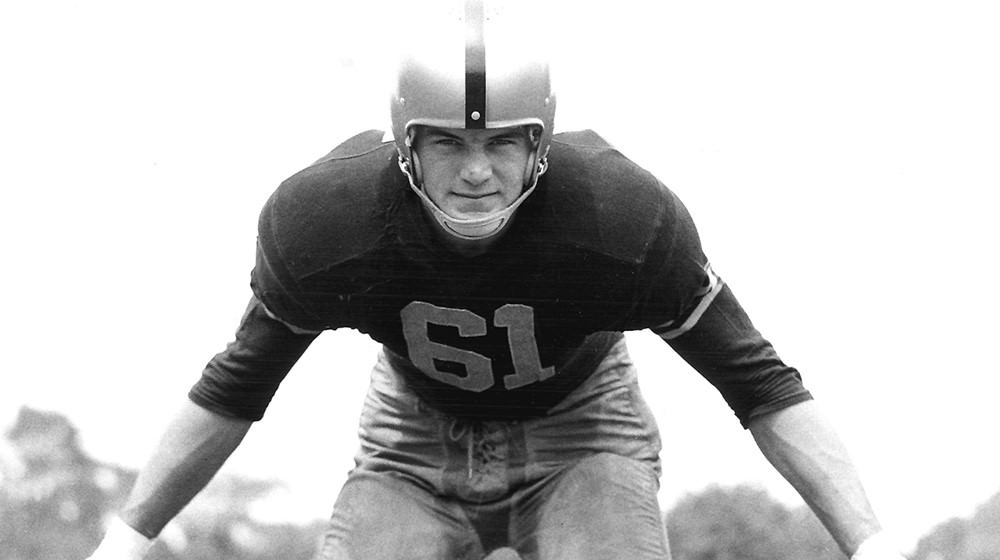

For the first time in 18 years, the College Football Hall of Fame will induct a former Army Black Knight. Last week, the College Football Hall of Fame listed former Army All-American Guard Bob Novogratz as part of its 2026 induction class, the 24th Black Knight to receive this honor. Novogratz was a 1958 first team All-American and All-East selection as well as a 1957 second-team All-East selection.
Army fans may remember Heisman Trophy winner Pete Dawkins, his backfield mate Bob Anderson, or the “Lonesome End”, Bill Carpenter, from the undefeated 1958 team, but Novogratz was just as important. Not only was he a First Team All-American that year, he also won the 1958 Knute Rockne Lineman of the Year award. In addition to blocking for two College Football Hall of Famers in Dawkins and Anderson, Novogratz played both sides of the ball and anchored a defense that allowed just 5.4 points per game.
Bob Novogratz ’59 selected for induction into the @NFFNetwork College Football Hall of Fame! 👏
— Army Football (@ArmyWP_Football) January 14, 2026
A First Team All-American at offensive guard in 1958, Novogratz is one of 18 players and four standout coaches in the 2026 Hall of Fame Class.
→ https://t.co/7rV4dJi4cF pic.twitter.com/Ut0bRVAfoA
A standout lineman for @ArmyWP_Football and a model of discipline and toughness, Bob Novogratz is a 2026 NFF College Football Hall of Fame electee. pic.twitter.com/Fg0h6bb7Os
— National Football Foundation (@NFFNetwork) January 14, 2026
Accounts of his career highlight his performances against Penn State and Notre Dame in 1957, where he combined for 48 tackles and played nearly every minute of both games. Although those performances are impressive, they may not even be his best performance. Bob Novogratz truly saved his best for last.
Despite entering the 1958 Army-Navy Game with a 7-0-1 record and the #5 spot in the AP Poll, Army found itself in a dogfight with the unranked Midshipmen. Heisman Trophy winner Pete Dawkins struggled throughout. He mustered just 37 yards on 12 carries and caught a single pass for 29 yards. The “Lonesome End” Bill Carpenter also proved a non-factor, catching just two passes for 24 yards.
Bob Anderson’s 29 carries for 89 yards buoyed the Cadets’ offense with Novogratz mostly paving the way. Newspaper accounts commended Novogratz’s blocking for opening holes for Anderson throughout the day. He helped clear a path for Anderson’s two touchdowns up the middle, which ultimately put Army ahead.
Amazingly, this was not his greatest contribution that day. Novogratza also recovered three fumbles, two Navy fumbles and one of Army’s own. His recovery of the Army fumble crucially preserved the Cadets’ second touchdown drive. Finally, Novogratz also recorded 18 of his 138 tackles in 1958 against the Midshipmen.
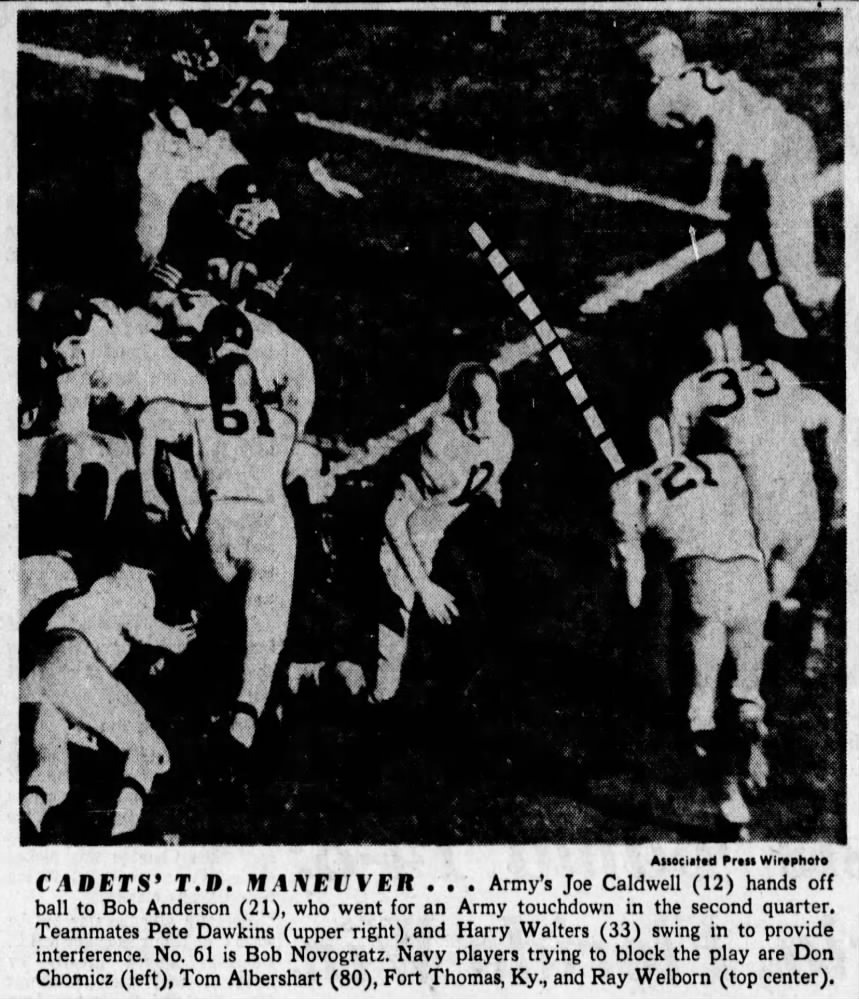
One could chalk it up to luck, but Novogratz’s three fumble recoveries and 18 tackles are one of the greatest individual efforts in program history. For reference, the Army Football Media Guide lists the season record for fumble recoveries at five. Novogratz’s three 1958 Army-Navy Game recoveries alone would place him tied for third for the single-season record.
Although Army left the 1958 Army-Navy Game with a 22-6 win, the game proved much closer on the field than the score indicated. After fumbling the opening kickoff and allowing a short Navy touchdown drive, Army did not take the lead until 33 seconds remained in the first half. They added their second touchdown on the opening play of the fourth quarter and returned an interception with less than two minutes for insurance. The Black Knights of the Hudson needed every bit of Novogratz’s contributions on both sides of the ball to get that crucial win.
Although it is difficult to confirm, one can reasonably attribute the revisiting of Novogratz’s career to the resurgence of Army’s football program overall. The College Football Hall of Fame has a “Veterans Committee” that oversees the cases of players from more than 50 years ago. Army’s return to the national limelight in today’s turbulent landscape likely resolidified the public’s reverence for the program’s place in College Football history. This increased respect could have swayed the Veterans Committee to induct Novogratz.
Novogratz’s induction gives hope for other forgotten Army Football legends. The College Football Hall of Fame requires inductees to have a First Team All-American selection from a major selector. The program has multiple All-Americans who meet this criteria. Could we soon see 1966 All-American LB Townsend Clarke or his 1968 All-American heir apparent, Ken Johnson in a future College Football Hall of Fame class? Novogratz’s induction makes this question more than a distant fantasy.
The 1958 Army team is one of the program’s most storied. Nearly 70 years later, Novogratz’s induction shows that there remains an important remnant of fans who remember Red Blaik’s triumphant final act.
Go Army!